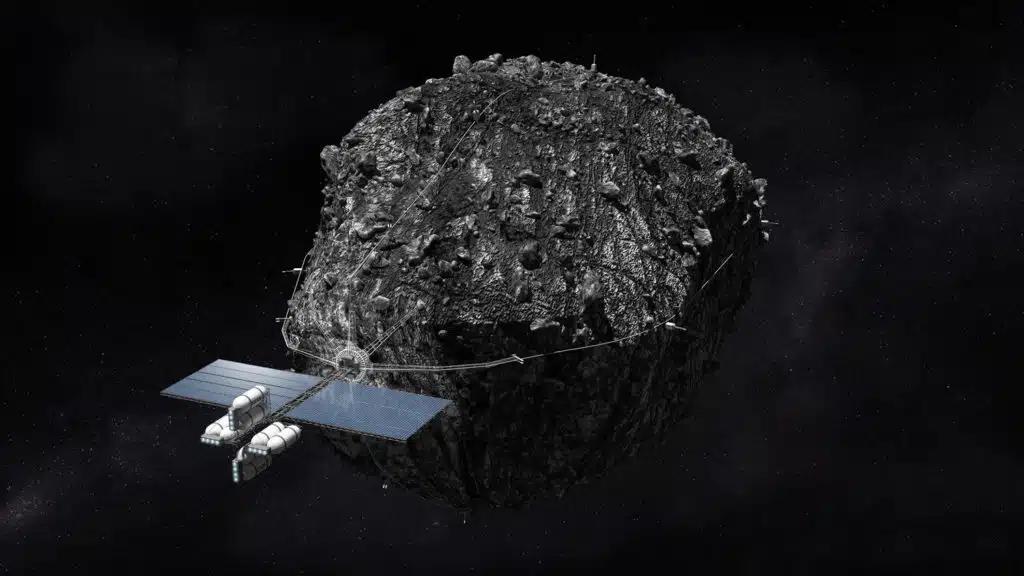
Asteroid Mining // Magnetic Rakes
← Return to Main

Harvesting the Invisible

On airless worlds, suction vacuums don't work.
Magnetic Rakes use powerful electromagnetic coils to "inhale" loose metal dust (regolith) from the surface without ever touching the ground.

The Extraction Sequence

πŸ“‘

1. The Sweep

The spacecraft hovers just a few meters above the asteroid surface. It extends a boom arm containing a series of rotating magnetic coils.

➀
🧲

2. The Jump

When the magnets activate, loose grains of Nickel and Iron fly upward, overcoming the asteroid's weak gravity and sticking to the rake's bristles.

➀
πŸ“₯

3. The Deposit

The rotating drum moves the captured dust inside the ship. The magnets turn off (or pass a scraper), causing the metal to fall into the cargo hold.

Magnetic Rake Diagram

Diagram showing field lines interacting with surface regolith.

Why Use Magnets?

Mechanical mining (shovels and drills) is messy. In zero-gravity, if you hit a rock with a shovel, the rock floats awayβ€”or your spaceship gets pushed backward.

Key Advantages

  • βœ“
    Zero Contact

    No physical contact with the ground means equipment doesn't wear out from abrasion.

  • βœ“
    Selective Sorting

    The magnets automatically separate valuable metal ore from useless silicate rocks.

  • βœ“
    Low Energy

    Requires only electricity (from solar panels), avoiding the need for heavy mechanical motors.

Target Environment

Magnetic rakes are specialized tools designed specifically for M-Type Asteroids.

M-Type (Metallic) Asteroids

These are the exposed cores of ancient protoplanets. They are composed almost entirely of Iron, Nickel, and Cobalt.

Fe (Iron) Ni (Nickel) Co (Cobalt)